Published on
2026 has been quite the year of reckoning for Chris Hansen and To Catch a Predator, with last year’s Predators and this year’s Primetime. The latter offers a dramatized look behind the scenes of the show. After watching Predators and being introduced to Primetime through its trailer, I decided to go back and watch the entire run of To Catch a Predator to properly familiarize myself with the subject matter before diving in. Let’s just say that was both a good and a bad decision when it comes to watching Primetime.
For the people who weren’t around in the early 2000s: To Catch a Predator was a hugely popular television segment hosted by Chris Hansen, in which online predators were lured to a house under the pretense of meeting a minor, only to be confronted by Hansen and eventually arrested. Primetime takes us behind the scenes of the show, following Hansen and his crew as they prepare for a new primetime slot and set their sights on a particularly high-profile target: a Texas assistant district attorney whose arrest could make television history.
I’ve written an in-depth article looking back at the show and exploring my conflicting feelings about it, so I won’t delve into that (much) here. Instead, the focus will be purely on the movie. While Robert Pattinson is the obvious star as Chris Hansen, the real heart of the story lies with Dan Plum, or Decoy Dan as he’s mostly referred to in the movie. He’s a young, struggling actor desperate to land his first credit when he’s hired to play the decoy: the guy who lures predators into the house and makes a bit of small talk with them until Hansen walks in to confront them. Dan is the fish out of water, completely unaware of what he’s actually auditioning for and thrown in at the deep end with barely any preparation. It’s a setup that practically screams artistic license.
Hansen himself is portrayed as a man hungry for success, with these predators seemingly offering him the perfect ticket to the big time. His main motivation is securing a primetime slot, where his show has to compete with the ratings juggernaut that is Lost. Remember that show? To beat those ratings, the team needs a real “whale”, someone whose arrest would generate the kind of headlines and audience interest they desperately crave. This ambition ultimately sets in motion the events that would bring the show to an end.
The NBC network executives are pushing for a high-profile bust, but there’s a problem with the show’s concept: most of the people caught in these stings come from the lower rungs of the socioeconomic ladder. Enter Bill Conradt, an assistant district attorney in Texas who poses online as a man in his twenties to engage in sexually explicit conversations with minors. Or, more accurately, with one particular minor in this case: a decoy working for Perverted Justice, the online vigilante group headed by Xavier Von Erck. It takes the team a while to establish Conradt’s identity, as he’s particularly cautious and hesitant in his online conversations. But once they figure out who they’re dealing with, he becomes their primary target. Simply filming his arrest would already be a major coup, but what they really want is to catch him in the act, on camera, for all of America to see.
That ambition would ultimately prove fatal, not only for Bill Conradt but for the show itself. Interestingly, the movie never actually depicts the aftermath of the sting. It also glosses over the lasting impact the events had on two of its central participants: Chris Hansen, who seems to have suffered relatively little beyond eventually seeing his show cancelled, and Dan, whose real-life counterpart has said that he wouldn’t relive that day for $20 million. That’s quite a price to put on one day’s work.
Primetime is an intriguing mid-budget movie, carried by Robert Pattinson’s excellent portrayal of Chris Hansen and Skyler Gisondo’s performance as Decoy Dan. Pattinson plays Hansen as a man utterly obsessed with his work and meticulous in every aspect of his job. One thing we often take for granted when watching television is the voiceover narration. Here, we get to see Hansen recording take after take of a single sentence, trying to find just the right delivery. It’s a small but effective detail that shows just how obsessive he is about getting everything exactly right.
The movie is largely shot like an actual TV program, even adopting the old-school 4:3 aspect ratio that television still used back then. A lot of attention has gone into recreating the stings and confrontations, and despite being dramatizations rather than the real thing, they manage to feel surprisingly authentic. However, having just watched the entire run of the original show, I found the dramatic liberties taken by the movie made for a somewhat frustrating viewing experience.
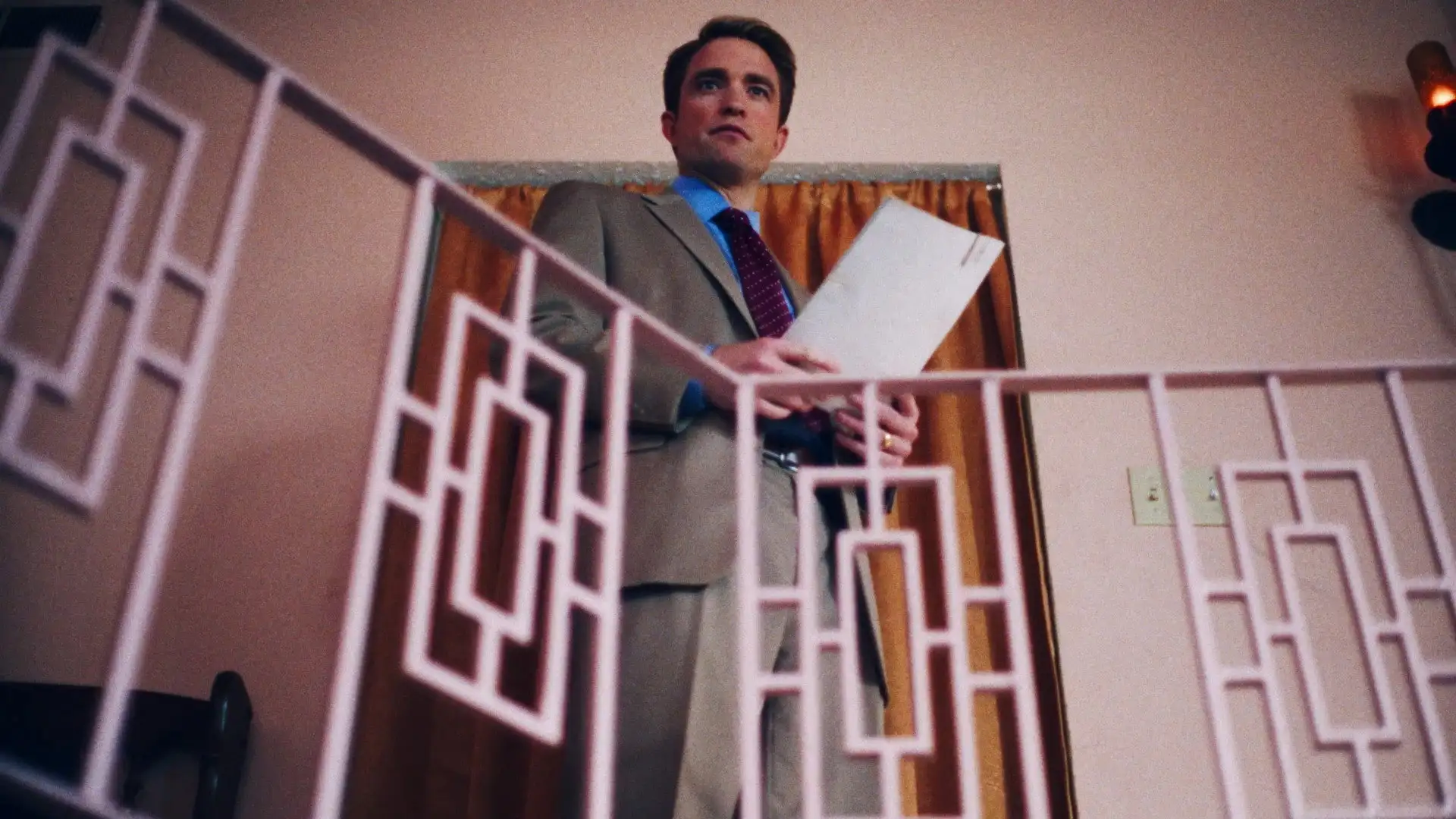
There are plenty of nitpicks to be made. For instance, one of the predators turns out to be a rabbi, but that particular encounter actually happened in the second episode of the series, long before the show made it to primetime. And Hansen always emerged from the adjoining room to confront the suspects; he never dramatically descended a flight of stairs as he does in the movie. These are understandable changes made for dramatic effect, but the biggest artistic liberties are taken with the Bill Conradt arrest.
There is an extensive article detailing this disastrous attempt to arrest a high-ranking member of society on television for the sake of ratings. The movie is based on this very articlet, although it doesn’t go into quite the same level of detail. It does, however, highlight how law enforcement not only invited To Catch a Predator to conduct a sting operation in Murphy, Texas, but also increasingly seemed to serve the needs of the television production rather than those of the public.
If you’ve seen the actual episode, what is portrayed here makes for a tense sequence, but it is hardly a reflection of what really happened. The events took place during the day, in an ordinary suburban neighbourhood, with Conradt holed up in a single-storey house with a sprawling layout. In the movie, however, everything happens at night, and the house looks more like a secluded villa. The filmmakers also put Decoy Dan at the scene, whereas in reality he was still at the sting house, where other men were continuing to show up. Hansen himself never witnessed Conradt putting a gun to his head either, as the house had very few windows facing the street. Only one or two police officers reportedly saw him shoot himself as they entered the premises. So, if you’ve watched the actual episode, the movie’s depiction of the arrest couldn’t be much further removed from what really happened.
But most viewers have probably never even seen that particular episode, and even if they have, chances are they won’t remember all the details. These changes do make for a more exciting sequence than what actually played out on television, where much of the footage consisted of cameras pointed at the lawn, police officers running around and, eventually, entering the house. Not exactly riveting television.
Chris Hansen himself has said that the movie felt detached from reality to him, and it’s not difficult to understand why. Primetime presents a heavily dramatized version of the show and, presumably, what went on behind the scenes. It’s a heightened take on the events, taking considerable liberties with the actual story, but one that nevertheless makes for an engaging viewing experience.
With a subject like To Catch a Predator, a movie like Primetime really ought to ask some difficult questions. And while it does raise a few, it ignores some rather obvious ones and leaves others hanging without ever seeming particularly interested in finding answers. Controversial aspects such as the accusations of entrapment are largely left untouched, at least in terms of any real reflection by the show’s participants. Yet the way the team goes about reeling in their “whale” feels uncomfortably similar to pushing a cigarette in front of someone who is trying to quit. Without the temptation of an apparently very eager young teen, would Conradt ever have engaged in this illegal behaviour? It’s a question the movie never really explores. Instead, Primetime spends more time on Hansen’s extramarital affair, an obvious device to portray him as a hypocrite.
Despite its lack of depth and unwillingness to tackle some of the more uncomfortable questions surrounding the show, I was thoroughly entertained throughout. It’s a skilfully made movie and a fascinating time capsule of an era when an entire country tuned in to watch Chris Hansen expose online predators on national primetime television.