Published on
Ask someone to name a Bruce Willis movie and chances are they’ll mention Die Hard or one of the many action hits on his résumé. Others might point to his acclaimed dramatic turns in Pulp Fiction, The Sixth Sense, or Unbreakable. Some will jokingly bring up the endless stream of straight-to-video releases that filled the last 15 years of his career, while a few movie buffs may even remember his first leading role in the 1987 comedy Blind Date. But almost nobody will mention his 1994 “erotic thriller”, Color of Night.
After a fellow psychiatrist is murdered by a mysterious figure, psychologist Bill Capa relocates to Los Angeles and takes over his friend’s group therapy sessions. While trying to uncover which of the patients may be responsible for the murder, he begins a passionate affair with the enigmatic Rose, a young woman who seems to have connections to several members of the group. As the body count rises and Capa finds himself the target of increasingly elaborate attacks, he must untangle a web of secrets, obsessions, and hidden identities before the killer strikes again.
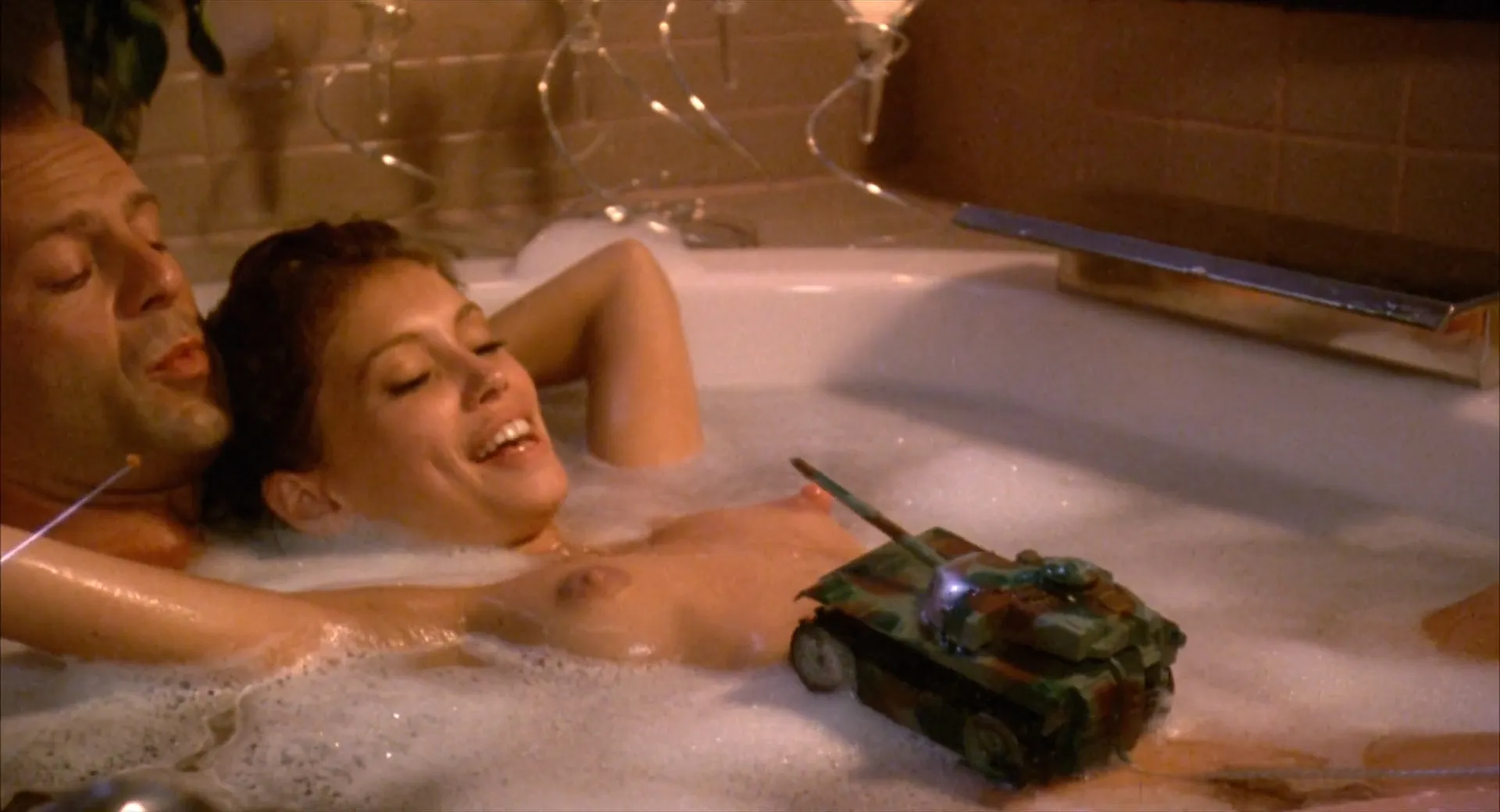
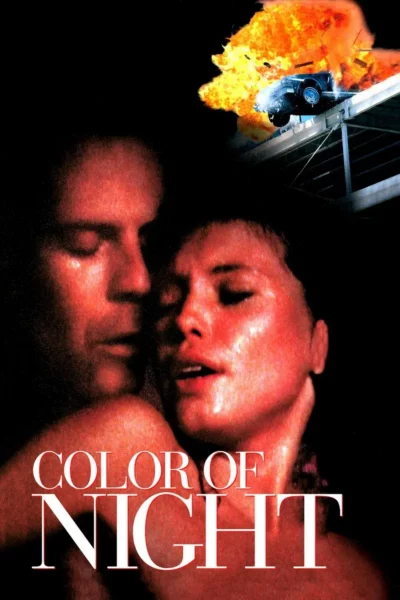
I was aware of this movie around the time of its release, but never actually got around to watching it. I knew about the dreadful reviews, and the marketing campaign—which seemed obsessed with images of Bruce Willis and Jane March lying naked in a swimming pool—did little to spark my curiosity. But with virtually every movie now available at the click of a button, I finally decided to give this forgotten Bruce Willis oddity a chance, revisiting a period when he still seemed invested in the projects he chose.
The reason I put the term “erotic thriller” in quotation marks is that, despite its reputation, the movie never really commits to being one. Yes, there are a handful of sex scenes, and they’re undeniably steamy and far longer than necessary to move the story forward, but if I counted correctly there are only about three of them in a film that runs close to two and a half hours. Unlike Basic Instinct or Body of Evidence, Color of Night never fully embraces the erotic side of the erotic-thriller formula. That makes the marketing campaign’s heavy reliance on images of Bruce Willis and Jane March lying naked together feel somewhat misleading. The one area where the advertising isn’t overselling things is Jane March’s screen time. Her character, Rose, spends a remarkable amount of the movie either nude or dressed in outfits that leave very little to the imagination. If there’s one character whose nudity feels gratuitous, it’s hers.
Then there’s the thriller aspect of the story. The premise is that Willis must discover which of his late friend’s patients is responsible for his murder. This leads to a series of one-on-one encounters with the various suspects, while Willis himself occasionally finds his life in danger. The most memorable of these sequences is a highway chase that culminates on a railway crossing, though the scene involving a rattlesnake hidden in a mailbox is memorable for entirely different reasons.
When Willis opens the mailbox and discovers the snake inside, he is startled and falls onto the road. Rather than simply backing away from the clearly visible threat, he remains sprawled on the ground, staring in terror at a snake that’s still sitting several feet away inside the mailbox. It’s one of those moments where the movie asks the audience to ignore basic common sense in order to manufacture tension, and the result is more unintentionally funny than suspenseful.

Like many thrillers of its era, Color of Night is fundamentally a whodunit, with virtually every supporting character positioned as a potential suspect. The film struggles, however, to effectively conceal where the audience should be directing its attention. Around the same time Willis’ character becomes involved with Jane March’s Rose, it gradually emerges that Rose has close—and often sexual—relationships with several of the other patients. It quickly becomes apparent that, whoever the killer turns out to be, they are almost certainly connected to her in some way.
The eventual revelation is surprisingly unsatisfying. The film treats it as a major twist, but rather than allowing the clues to fall into place naturally, it resorts to the classic “talking killer” finale. The culprit spends an excessive amount of time explaining the plot, motivations, and connections in painstaking detail, as if the filmmakers didn’t trust the audience to piece any of it together themselves. Instead of feeling clever or shocking, the ending comes across as overexplained and oddly anticlimactic.
The patient group is easily one of the movie’s more interesting elements, consisting of a colorful collection of troubled personalities portrayed by a surprisingly strong cast. Among them are genre veterans Lance Henriksen and Brad Dourif, both of whom bring some much-needed character to the proceedings.
One aspect that stood out to me was the inclusion of a character struggling with gender identity. For a mainstream Hollywood thriller released in 1994, that was a surprising subject to incorporate into the story. The portrayal is somewhat confusing by modern standards, however. The character is played by an actress who visually reads as a young woman presenting as male, yet the dialogue identifies the character as a boy who wishes to transition to female. If this movie were made today, this character would likely generate plenty of controversy and debate from one side of the culture war.
But this character is also where the movie starts to wobble. It’s so transparently someone in disguise that they become the obvious answer to every question the film is asking. Especially once everyone else in the group suddenly starts dating off-screen women at the same time, except for Sondra (Lesley Ann Warren), the sexually charged patient locked into a lesbian relationship. And at that point, it doesn’t take a genius to connect the dots.
Let’s say you want to watch Color of Night. I have no idea why—maybe you’re curious about all the fuss surrounding Jane March’s infamous nude scenes, or perhaps you’ve heard that the movie contains a brief glimpse of Bruce Willis’ anatomy—but let’s assume you’re determined to give it a shot. If you want to avoid spoilers, don’t make the same mistake I did and look up the cast list too closely. Doing so practically gives away the film’s big twist, as one actor ends up playing more than one role.
Once you look at the film more closely, the whole thing quickly collapses under the weight of its own logic. Willis’s character casually inherits his dead friend and colleague’s entire patient group, because apparently that’s how psychiatry works now. He also moves straight into his friend’s house, which just happens to be an active crime scene, and nobody bats an eye. Meanwhile, every character in the group conveniently starts dating a young, attractive stranger who no one can identify again the moment she throws on a wig, as if facial recognition is optional in this universe.
In the end, Color of Night was a long but occasionally interesting watch. It was enjoyable to finally cross a Bruce Willis film from his prime off my list, and the cast is filled with familiar faces. Jane March is undeniably captivating on screen. Ultimately, though, the movie is more disappointing than rewarding. Unlike the gleeful insanity of a film like Hudson Hawk, Color of Night never becomes entertaining enough to overcome its flaws. Instead, it settles into mediocrity and gradually fizzles out during the third act.