Published on
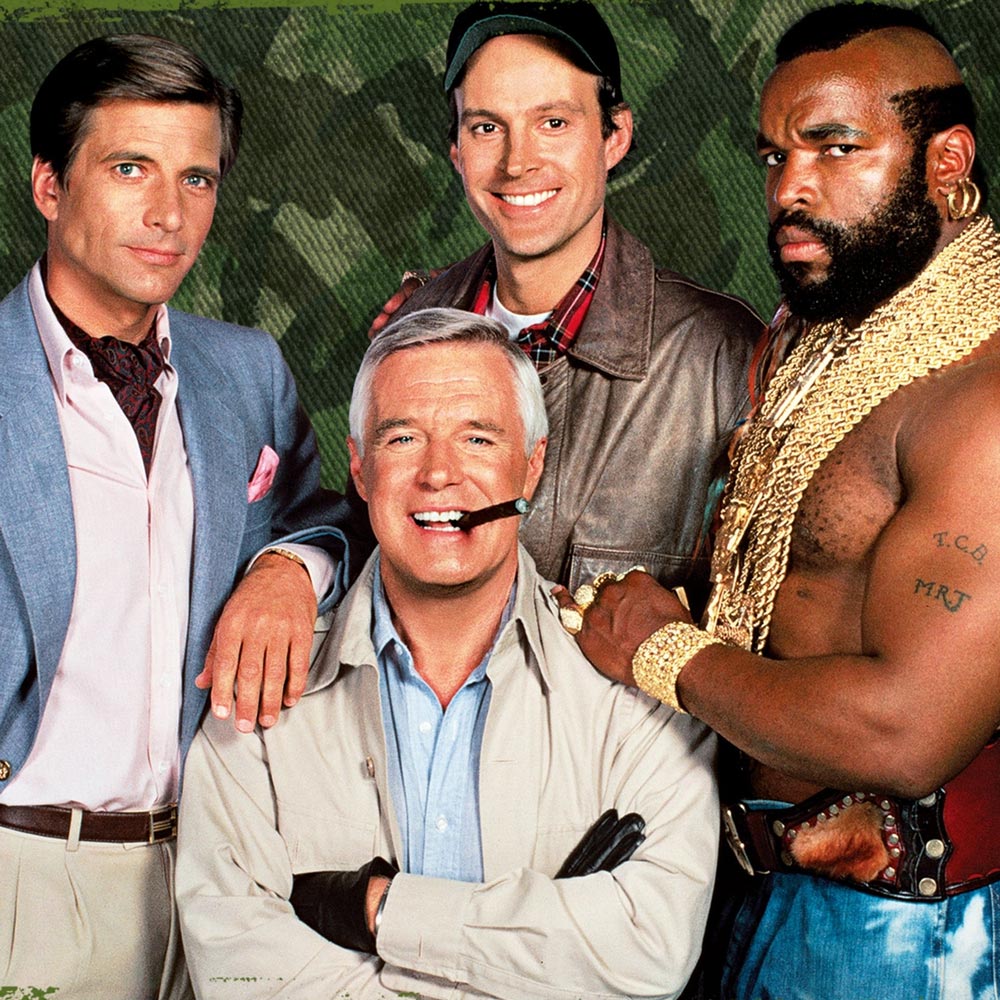
As a child of the 1980s, I grew up on shows like The A-Team. Alongside classics such as Knight Rider and The Dukes of Hazzard, this tale of four former soldiers on the run for a crime they didn’t commit was a staple of my childhood. I spent countless afternoons watching Hannibal’s plans come together, laughing at Murdock’s insanity, and wondering how B.A. could survive yet another flight. The show was simply part of growing up.
Despite the endless reruns over the years, however, I realized I had never actually watched The A-Team from beginning to end. Like many shows from that era, I experienced it as a collection of random episodes rather than a complete series. This rewatch finally gave me the opportunity to see the show in its entirety and find out whether one of my childhood favorites still holds up decades later.
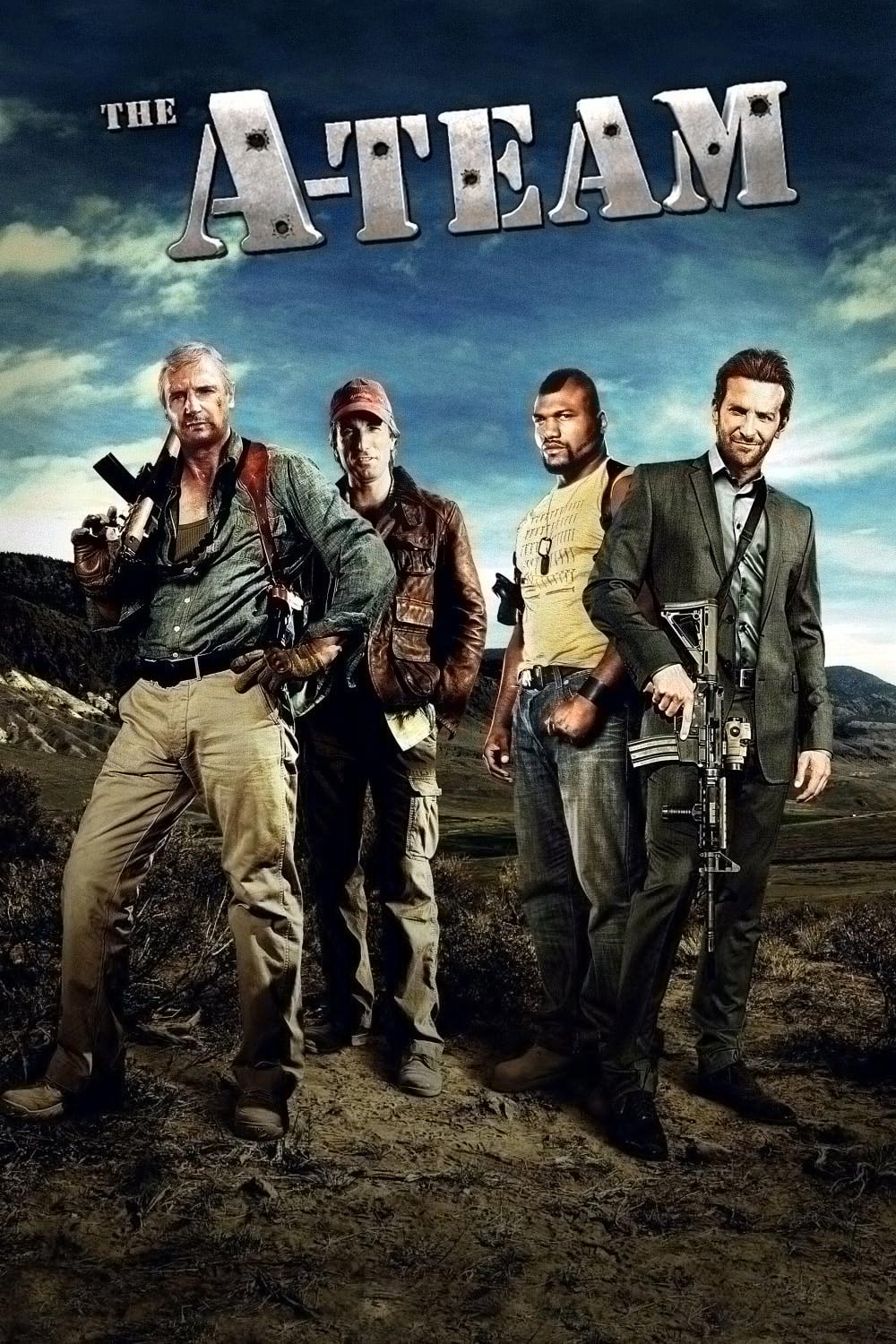
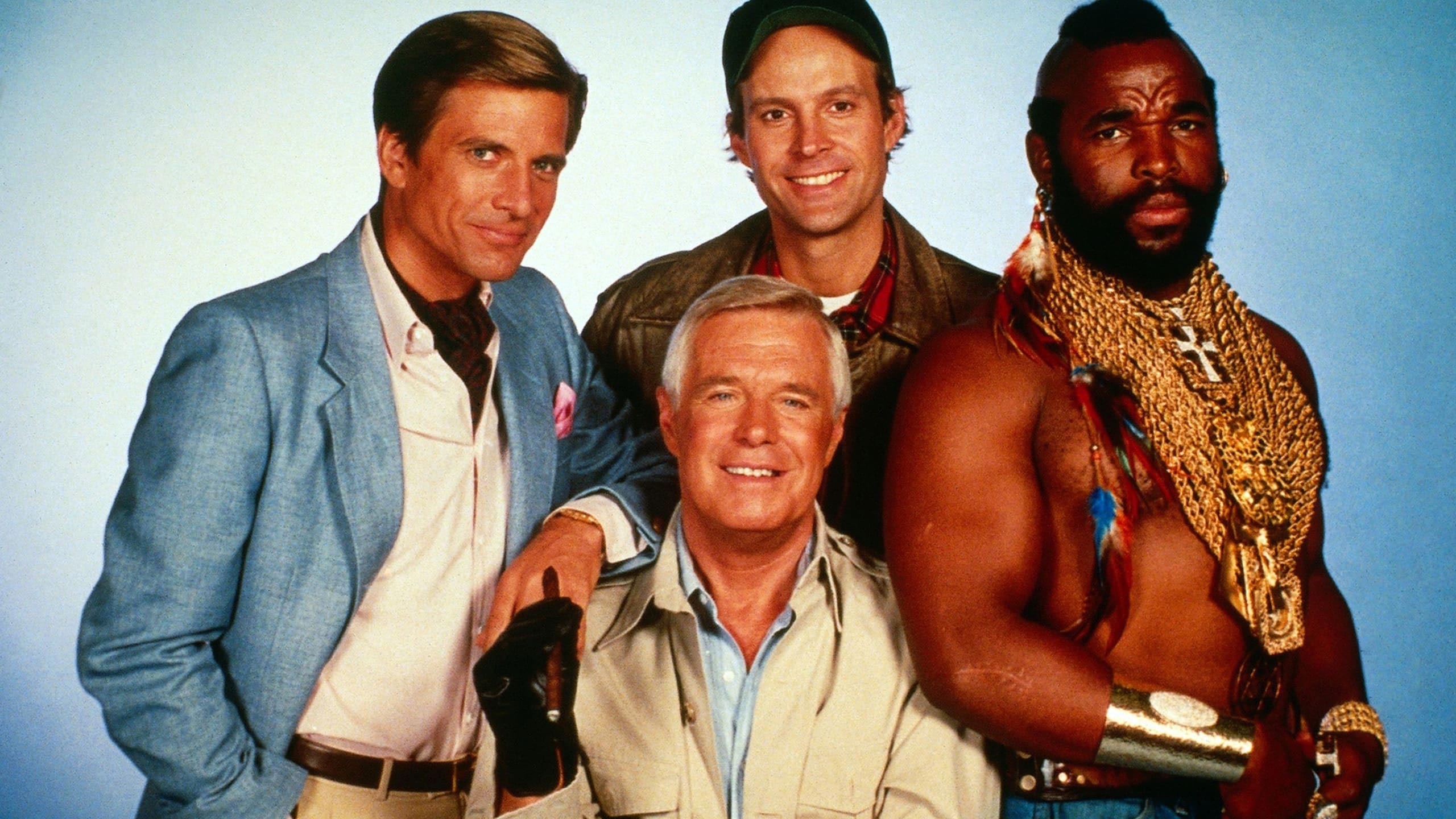
The A-Team is an action-packed TV series that follows the thrilling adventures of a group of ex-U.S. Army Special Forces soldiers turned mercenaries. Framed for a crime they didn’t commit during the Vietnam War, the team escapes military custody and now operates as fugitives. While on the run, they use their exceptional skills to help those in need, often taking on dangerous and seemingly impossible missions for the innocent and oppressed.
The team is led by the cigar-chomping Colonel John “Hannibal” Smith, known for his brilliant tactical mind and love of “a plan coming together”. His crew includes Templeton “Faceman” Peck, the smooth-talking con artist who secures resources for their missions; Bosco “B.A.” Baracus, the tough-as-nails mechanic and muscle of the group who also has a fear of flying; and H.M. “Howling Mad” Murdock, the eccentric yet highly skilled pilot whose unpredictable behavior provides comic relief.
Each episode delivers explosive action, elaborate schemes, and a healthy dose of humor as the A-Team stays one step ahead of their pursuers—most notably the ever-frustrated Colonel Decker—while helping those in need and trying to prove they’re not the criminals the military made them out to be. The series became famous for its unique brand of violence: hundreds of rounds are fired every episode, vehicles explode spectacularly, yet almost nobody ever gets seriously hurt. In many ways, The A-Team was a live-action cartoon, and its larger-than-life characters—especially the wildly unpredictable Murdock—only reinforced that feeling. It’s a world where impossible plans always work, bad guys are more likely to crash a jeep than hit their target, and entertainment always takes priority over realism.
The show ran for five seasons, with the final season taking a different approach that ultimately led to its midseason cancellation. This abrupt ending was a disappointing conclusion to a series that has otherwise remained a syndication staple for over 40 years. However, behind-the-scenes anecdotes that have surfaced over the decades reveal a more turbulent reality on set. Veteran actor George Peppard, for instance, reportedly clashed with his co-stars, creating a tense work environment. He was notoriously difficult to work with, playing a key role in the dismissals of female cast members Melinda Culea and Marla Heasley, and fostering a strained relationship with Mr. T—especially after discovering that Mr. T was earning a higher salary than him. These stories add a complicated layer to the legacy of a show that still resonates with fans worldwide.
A typical episode of The A-Team follows a well-established formula that has become one of its defining characteristics. Each episode usually begins with someone in trouble seeking the team’s help, followed by the A-Team devising an elaborate plan to take on the villains. The middle act often involves clever tactics, resourceful improvisation, and the inevitable construction of a makeshift weapon or vehicle. The climax features an explosive showdown where the team triumphs, all while delivering witty banter and a few well-placed one-liners. This consistent structure not only makes the show highly accessible, with episodes functioning as largely standalone adventures, but also creates a comforting sense of familiarity for viewers. However, this predictability can also limit narrative depth, as the episodic nature leaves little room for ongoing character development or overarching storylines.
This approach was common in most pre-millennium shows, as the ability to easily rewatch a missed episode simply wasn’t available at the time. Networks prioritized episodic storytelling to ensure viewers could drop in at any point without feeling lost, making standalone plots and self-contained character arcs the norm. For The A-Team, this format worked particularly well, as it allowed audiences to enjoy action-packed escapades without needing to follow a complex ongoing narrative.
Here’s a breakdown of each season of The A-Team, exploring its evolving dynamics, highlights, and the challenges it faced:
Season 1 (1983)
The inaugural season introduces the team and establishes the show’s formula. Kicking off with the two-part pilot “Mexican Slayride”, the season sets the stage for the A-Team’s fugitive status, their altruistic missions, and their larger-than-life personalities. Key cast members include Melinda Culea as Amy Allen, a journalist who aids the team and serves as a quasi-regular. The episodes focus on small-scale stories, often featuring rural settings and ragtag enemies. While the budget was modest, the novelty of the show and its unique mix of humor, action, and heart made it an instant hit.
Like the final season, the first season is relatively short, featuring only 13 episodes—or 14 if you count the two-part pilot, “Mexican Slayride”, as separate installments. Despite its brevity, this season includes several standout episodes, some of which are particularly memorable because key shots from them were immortalized in the iconic title sequence. One hallmark introduced early on is the inclusion of familiar faces among the guest stars, adding an extra layer of excitement for viewers. John Saxon makes a notable appearance as a cult leader in Episode 2, “Children of Jamestown”. Other recognizable character actors who make their mark in this inaugural season include Clifton James, Ed Lauter, Sid Haig, Amy Steel, Andrew Robinson, Xander Berkeley, Joanna Kerns, and M.C. Gainey.
Rewatching it in HD made the use of stunt doubles more glaring than ever. In numerous fight scenes, the show cuts back and forth between the actual actors and their obvious stunt doubles, often in the same shot. Stunt doubles also fill in during car chases and even in simple b-roll of the A-Team van cruising around. The result? A black stuntman, wearing a mask to replicate Mr. T’s iconic mohawk, is unmistakably filling in for the star. This level of amateurism only adds to the show’s charm, enhancing its humor, even if unintentionally.
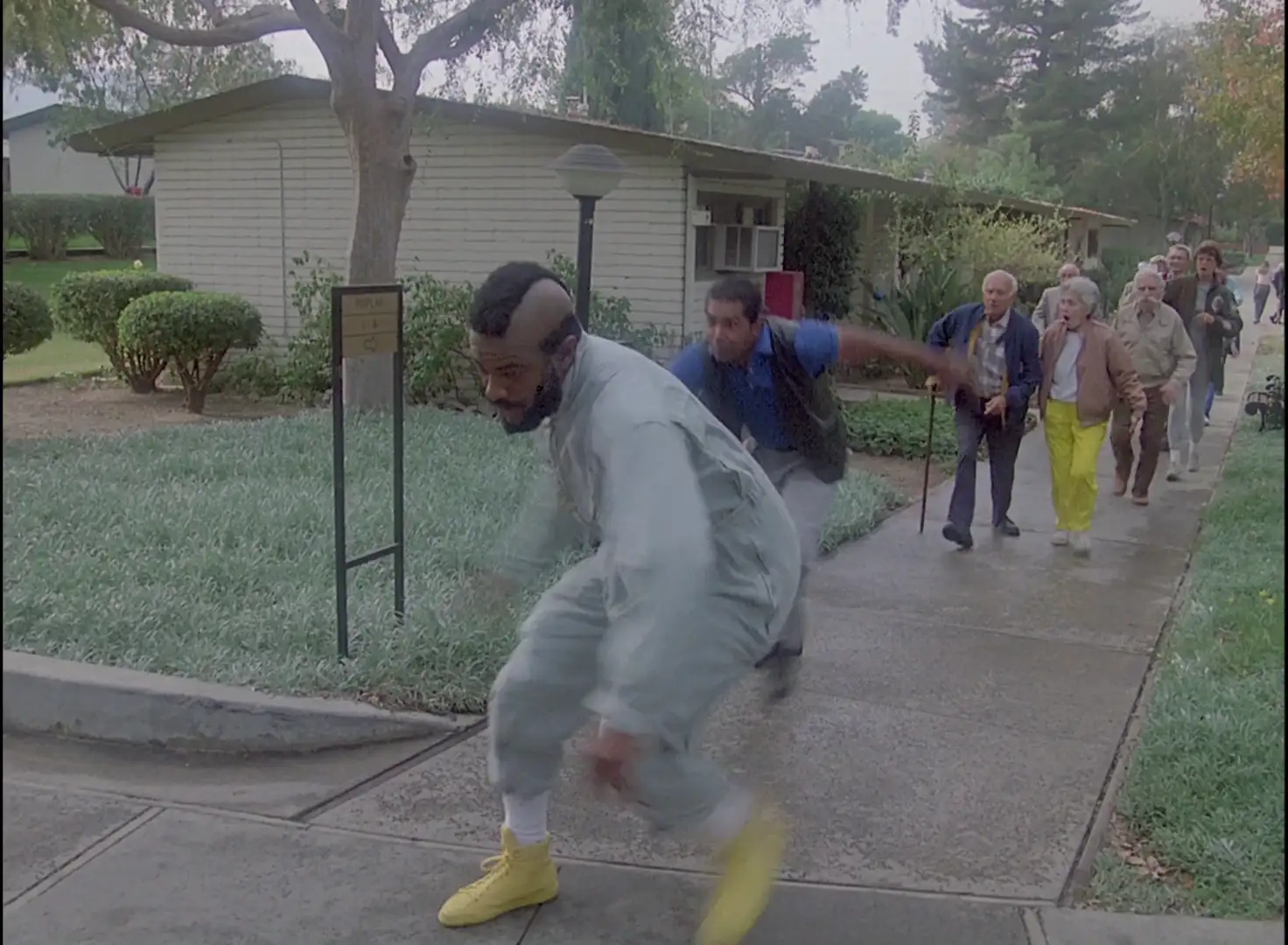
Mr T’s stunt double in the season 5 episode “The Grey Team”
Season 2 (1983–1984)
 With growing popularity, Season 2 expands on the show’s formula with bigger action sequences and more elaborate plots. Melinda Culea’s departure mid-season marks a behind-the-scenes shift, as her character was written out after reported tension with George Peppard. Marla Heasley is introduced as Tawnia Baker, another female ally, though her presence feels less prominent. The season also solidifies recurring gags, like B.A.’s fear of flying and Hannibal’s penchant for disguises. The show’s tone leans more toward humor, solidifying its appeal to family audiences. It’s also the first full season of The A-team, consisting of 23 episodes.
Most of the episodes in Season 2 stick closely to The A-Team’s tried-and-true formula, but a few manage to stand out. The standout episode is “Deadly Maneuvers”, in which the team faces off against a sinister version of themselves—a group of mercenaries hired by people whose plans and businesses the A-Team had thwarted in the past. This clever twist on the usual format showcases the team’s ingenuity against an equally formidable opponent.
Season 2 also boasts an impressive roster of guest stars, with familiar faces like Michael Ironside, Ernie Hudson, Brion James, Charles Napier, John Vernon, James Hong, Lance Henriksen, Mako, Kurtwood Smith, John Amos, Tony Burton, Dennis Franz, Ken Foree, and Dana Kimmell making appearances. Additionally, this season introduces a recurring quirk of the series: guest stars returning to play entirely different roles. Clifton James, Ed Lauter and Andrew Robinson all make return appearances as new characters. The most notable example, however, is Marla Heasley, who joined the show as series regular Tawnia Baker in the latter half of the season but had already played a different character, Cherise, in Episode 4.
This practice reflects the more forgiving nature of pre-streaming television, when weekly episodes aired without the constant scrutiny of rewatching or online analysis.
Season 3 (1984–1985)
By Season 3, The A-Team is riding high at the peak of its popularity. The show leans fully into its formula: ever more elaborate schemes, ever more outrageous contraptions, and an endless supply of everyday objects magically repurposed into heavy artillery. With only a handful of exceptions, episodes stick so closely to the template that it starts to feel as though America is overrun with crooked businessmen who routinely hire goons to strong-arm the common man.
The season’s most notable shift is the departure of Tawnia Baker, who appears only in a two-part episode originally produced for Season 2. Reportedly, George Peppard pushed for her exit, believing a permanent female team member was unnecessary. It’s hard to argue with the results: the series functions perfectly well without the “embedded reporter” angle. Besides, each week already delivers at least one beautiful woman—either as a damsel in distress or an accessory to the villain’s latest scheme.
By this point, most episodes are practically interchangeable. The plot rarely strays: a small business owner hires the A-Team, the business—be it a hotel, fire department, lumber company, diner, or towing service—is under siege from ruthless criminals, and our heroes roll in to save the day. Only the storefront changes; the beats remain the same. That repetition makes it difficult to single out a favorite, but “Bounty” rises above the pack, if only because it lets Murdock get the girl for once.
Season 3 also boasts a veritable who’s who of ’80s character actors. Familiar faces like Charles Napier, Paul Gleason, Xander Berkeley, Robert Davi, Joseph Wiseman, Benji Gregory, John Ashton, Daphne Reid, John Saxon, Dennis Franz, Bruce Glover, and Branscombe Richmond pop up throughout the season—some of them for the second or even third time in different roles, which has become a charming (if noticeable) tradition of the show.
If there’s one element that truly stands out this season, though, it’s the heavy-handed use of ADR. Time and again, we hear Hannibal or another team member delivering exposition over establishing shots or footage of the van cruising down the highway, supposedly in conversation with unseen characters. The dialogue sounds so stiff and artificial that it’s painfully obvious these lines were dubbed in later to patch narrative gaps.
The most egregious example comes in “Trouble Brewing”. In the final scene, B.A. reacts to a swaggering Murdock. As the camera lingers on his face, a painfully unconvincing imitation of Mr. T’s voice pipes in: “Hey sucker! You’re dead meat. Understand?” The frame freezes awkwardly halfway through the sentence, compounding the absurdity. It’s a baffling post-production choice—one that adds nothing and only draws attention to itself in the worst possible way.
Season 4 (1985–1986)
 Considering the general consensus that season 4 is where the show began to decline, both in quality and ratings, this is easily my favorite season of the entire series. While it’s often described as being grittier than the earlier seasons, I don’t really see that, unless people are basing that reputation entirely on the finale, “The Sound of Thunder”. That episode sends the team back to Vietnam, features traumatic flashbacks, and includes the onscreen shooting death of a major character. Murdock gets hit as well. It’s probably the bleakest and most emotionally heavy episode the series ever produced, and judged solely on that episode, I can understand where that perception comes from. But the rest of the season is mostly just fun — at times, it’s arguably the lightest and most playful the show ever became.
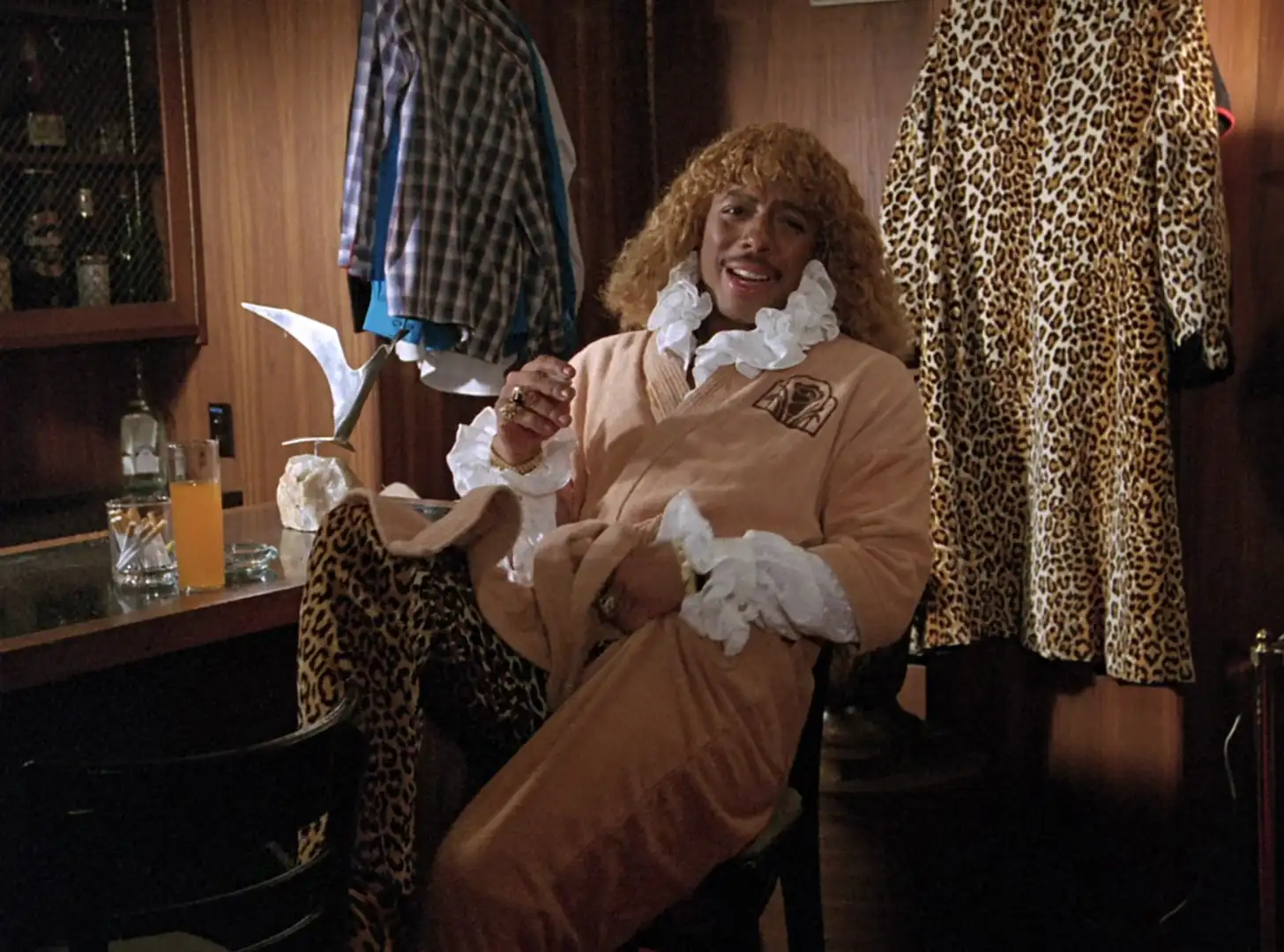
One of the defining aspects of this season is its heavy use of stunt casting. Unlike the previous seasons, season 4 leans hard into contemporary celebrity appearances to generate buzz and boost ratings. The season features guest spots from Rick James, Isaac Hayes, Boy George, and Hulk Hogan, which gives the show a bigger, more event-like feel than the previous seasons, where the villains of the week were usually played by familiar character actors. That said, this season still has plenty of those as well, alongside the celebrity cameos.
But I found this season incredibly entertaining. The celebrity cameo episodes are obvious standouts, but there’s plenty more here that makes the season memorable. The team goes undercover on a cruise ship in an episode that practically feels like a crossover with The Love Boat. There’s an episode centered around Hannibal making a movie called The Aquamaniac. We finally meet B.A.’s mother, who affectionately calls him “Scooter”. The A-Team even becomes part of a neighborhood watch program, and one episode revolves around Face trying to get into an exclusive country club, only to discover that General Fulbright is already a member there — an entire setup that feels ripped straight out of an ’80s screwball comedy like Caddyshack.
So I’ve never really understood the hate this season gets. Sure, there are still plenty of run-of-the-mill episodes that stick closely to the familiar A-Team formula, but almost none of them are outright bad. The only thing that occasionally stands out is how some episodes noticeably sideline certain team members, with them appearing only in the opening and closing scenes. There are also a few episodes where the team spends most of the runtime split up. Those moments are probably the clearest signs of the strained relationships between the cast behind the scenes. Still, it never becomes a major issue, and overall I genuinely enjoyed this season a lot.

Boy George as himself in the infamous “Cowboy George” episode
Season 5 (1986–1987)
In an effort to rejuvenate the series, Season 5 introduces a new premise: the A-Team is finally captured by the government but offered a deal to work as covert operatives in exchange for a pardon. This shift changes the dynamic significantly, with new character General Hunt Stockwell (Robert Vaughn) acting as their handler and Frankie Santana (Eddie Velez) joining the team as a special effects expert. While the new direction adds a fresh twist, it alienates many long-time fans, and the ratings plummet. The show is ultimately canceled midseason, bringing The A-Team to an abrupt and disappointing end.
These episodes mostly revolve around The A-Team being sent on near-suicidal missions across the globe, usually involving spies, international conspiracies, and Cold War intrigue. Many of the stories take the team to places such as East Germany, Hong Kong, and Australia. Of course, in reality this mostly means California standing in for half the world, supplemented by a few sound stages and stock footage. One episode that is supposedly set in Spain even features streets filled almost exclusively with American cars, which are a rarity in Europe and make the illusion rather difficult to maintain.
As a result, the show often feels strangely disjointed. Gone are the small-town American settings where ordinary people needed help dealing with some local bully, corrupt businessman, or land-grabbing villain. That formula was undoubtedly becoming repetitive after several seasons, but it was also a major part of the show’s identity. By shifting its focus to globe-trotting spy adventures, the series loses much of its blue-collar charm and underdog appeal. The stakes may be bigger, but the stories often feel less personal, and with that, some of the heart that made The A-Team so enjoyable gets left behind.
What also becomes increasingly obvious is that the behind-the-scenes tension between Mr. T and George Peppard had started to affect the show itself. Their screen time is noticeably reduced in multiple episodes. Face, Murdock, and Frankie dominate most of the stories, with some episodes relegating B.A. and Hannibal to what are essentially guest appearances in their own series. There are even moments where B.A. is quite literally represented by a mannequin because the scene simply requires his presence. On top of that, there are numerous instances where he’s clearly being played by a stunt double. More often than not, whenever B.A. is seen from behind, it’s painfully obvious that you’re not actually looking at Mr. T.
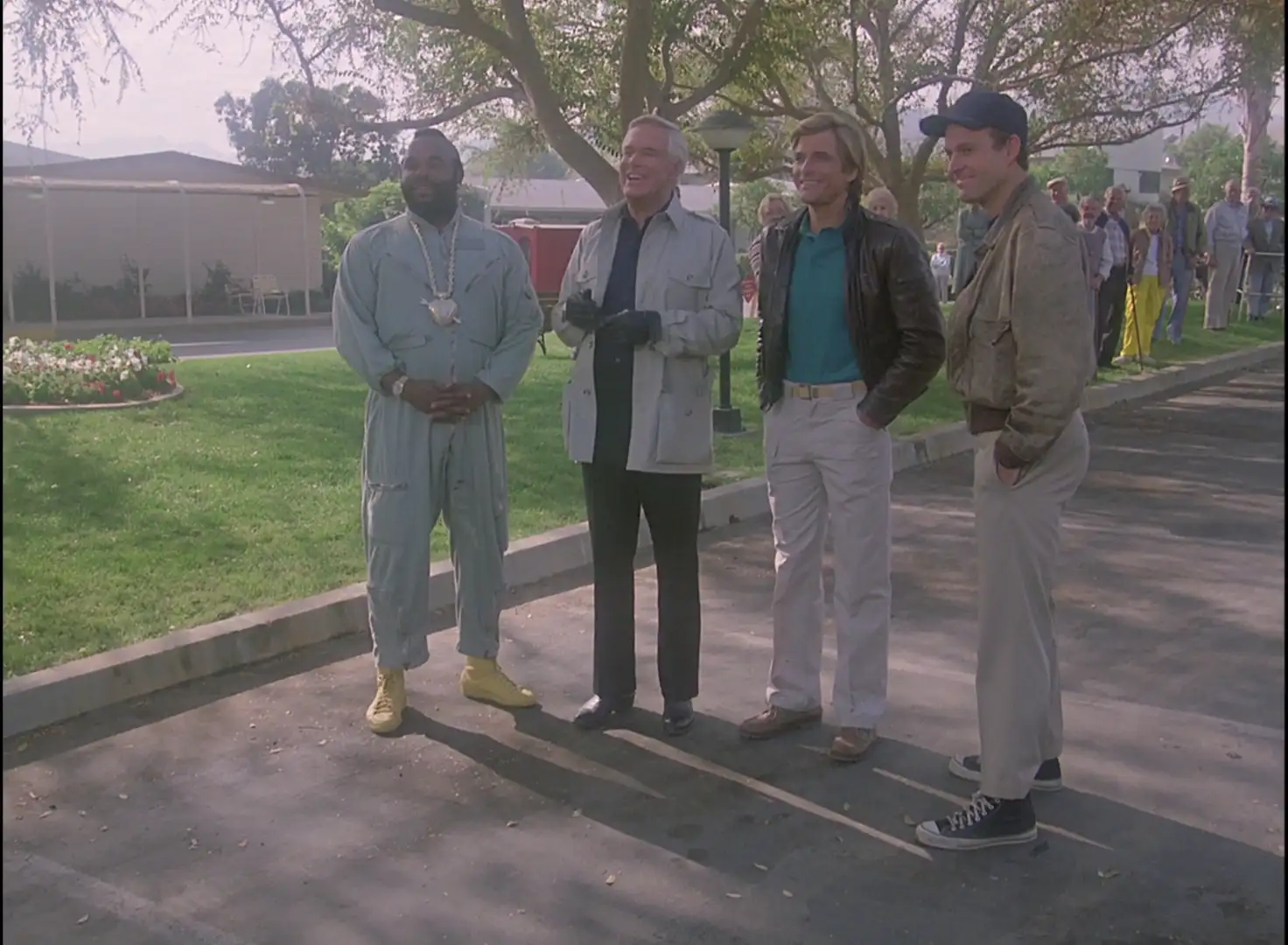 Despite being the weakest season of the show, it does contain two genuinely funny episodes. “The Spy Who Mugged Me” is an affectionate James Bond spoof that works largely thanks to a fantastic performance from Dwight Schultz, whose Sean Connery impression is surprisingly spot-on. The other highlight is “The Grey Team”, the unofficial finale of the series and the episode that comes closest to recapturing the spirit of the show’s early years. It’s a lighthearted story that sees Hannibal essentially giving Stockwell the finger while the team finds itself matched by a group of resourceful senior citizens. Even the final moments feel like a farewell. The only frustrating aspect is that this is technically the penultimate episode. During the original broadcast run it served as the finale, but every rerun package and home media release places a previously shelved episode after it, despite that episode having originally been intended to air before “The Grey Team”.
The actual finale is surprisingly small in scope. The episode revolves around Murdock working at a restaurant that suddenly turns into a hostage situation when three hitmen show up to assassinate an attorney general. The stakes are unusually high for The A-Team, as Face gets shot early on and spends most of the episode clinging to life. Meanwhile, Hannibal and B.A. are sidelined for much of the runtime, sitting at home watching a football game while the action unfolds elsewhere.
While the episode itself is entertaining enough, it feels like an odd way to end such an iconic series. With almost the entire story confined to a single restaurant set and only half the team actively involved for the most part, the show goes out with a whimper rather than a bang. If you’re watching the series today, I’d actually recommend swapping episodes 12 and 13. Episode 12 feels far more like a proper series finale and provides a much stronger sense of closure than the episode that officially ended the show.
The final season isn’t terrible, but it is somewhat depressing to watch a once-fresh and immensely entertaining show desperately trying to stay relevant by abandoning many of the elements that made it popular in the first place. The globe-trotting spy plots and darker tone occasionally provide interesting variations on the formula, but they also make the series feel less like The A-Team. It’s still watchable, and sometimes even very enjoyable, but it ultimately feels like a show that had lost sight of what made it special.
Legacy
Despite its uneven run, The A-Team remains one of the defining television shows of the 1980s. Revisiting it decades later, I was reminded of why it captured my imagination as a child. The action is often ridiculous, the plots are wildly repetitive, and the show’s relationship with realism is tenuous at best, but none of that really matters. At its best, The A-Team is pure entertainment, carried by four immensely likable characters whose chemistry makes even the weakest episodes watchable.
Watching the series from beginning to end for the first time also revealed its flaws more clearly than ever before. The later seasons struggle to recapture the magic of the early years, and the behind-the-scenes tensions occasionally become visible on screen. Yet even when the show stumbles, it never completely loses its charm. More than forty years after its debut, The A-Team remains a perfect snapshot of 1980s television: loud, unapologetically fun, and impossible not to smile at when Hannibal lights a cigar and says, “I love it when a plan comes together”.